What is a sisal basket?
A sisal basket is woven from sisal, a strong natural fiber that comes from the leaves of the Agave sisalana plant. Kenya is one of the world's leading sisal producers, and Zawadisha's baskets are handwoven in Taita Taveta County, Kenya, from locally grown sisal.
Who makes Zawadisha's sisal baskets?
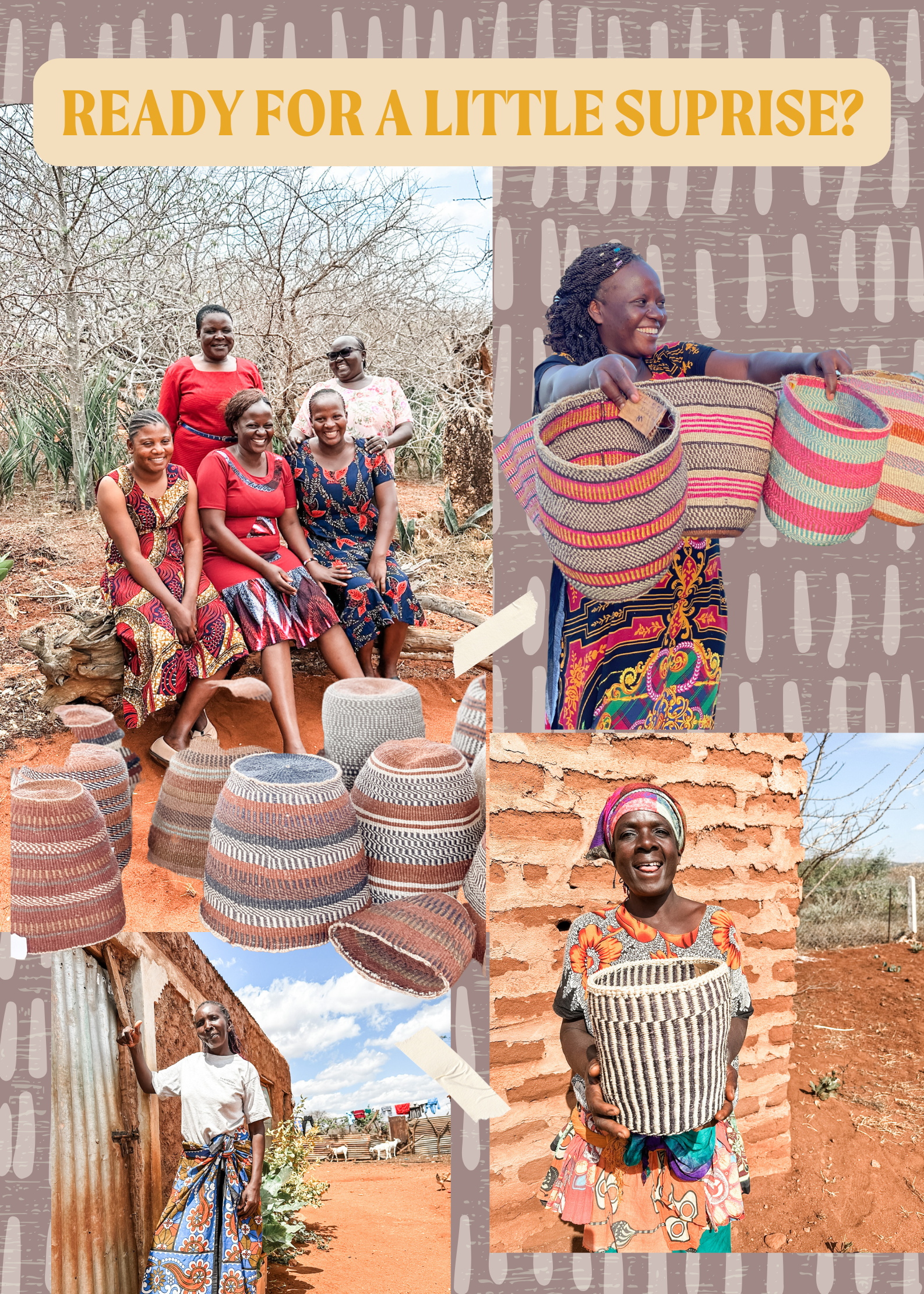
Our baskets are woven by women in Zawadisha's community in rural Taita Taveta County, Kenya. They're the same women who receive microloans from Zawadisha. Every basket has a tag inside with the name of the woman who wove it.
What's the difference between thick weave and fine weave sisal baskets?
Thick weave baskets are woven with thicker strands of sisal for a chunky, textured look. Fine weave baskets use thinner strands for a tighter, smoother finish. Both are handwoven and sturdy.
What sizes do Zawadisha's sisal baskets come in?
XXS – about 8 cm (3 in): jewelry, keys, paper clips, tiny succulents
XS – about 13 cm (5 in): makeup, remotes, small potted plants
S – about 18 cm (7 in): fruit, mail, craft supplies
M – about 24 cm (9.5 in): bread, kids' toys, a 6-inch potted plant
L – about 30 cm (12 in): magazines, yarn, a larger potted plant
XL – about 36–38 cm (14–15 in): throw blankets, toys, kindling
Every basket is handmade, so sizes are approximate.
Will I get the exact basket in the photo?
Yes. Every basket is one of a kind, with its own colors and pattern, and each listing shows the actual basket you'll receive. Once it's gone, it's gone.
Can I put a plant in my sisal basket?
Yes! Keep the plant in its own pot with a saucer or waterproof dish underneath, so soil and water never touch the sisal.
Can I use my sisal basket for bread or fruit?
Yes. Sisal baskets are lovely for bread, rolls and whole fruit. Add a cloth napkin if you'd like to catch crumbs.
How do I care for a sisal basket?
Keep it dry and out of direct sunlight, which can fade the dyes. Spot-clean with a soft, slightly damp cloth, and never soak or machine-wash it. If it gets wet, let it air dry somewhere with good airflow. It's happiest indoors or on a covered porch. Read our full care guide: https://www.zawadisha.org/blogs/journal/how-to-care-for-your-sisal-basket
Will my basket need to be reshaped when it arrives?
Nope. Your basket arrives ready to use.
Is sisal sustainable?
Sisal is a natural, plant-based fiber that is biodegradable and known for its strength and durability. With gentle care, a sisal basket can last for many years.
How does buying a sisal basket help the women who make it?
In rural Taita Taveta, the rains don't always come, and farming alone often isn't enough to support a family. Weaving gives women a way to earn their own income at home, around farm and family work, and our weavers work together in groups. Each weaver is paid a fair wage for every basket. Proceeds from our shop and the sale of our sisal baskets fund our microlending program for women in Kenya. So your basket does double duty: income for the woman who wove it, and funding for the next round of loans. For our weavers, that income means school fees paid and healthcare covered.
Why does weaving income matter so much for women in rural Africa?
Across rural Africa, wage jobs are scarce, especially for women, and harvests depend on the rains. Weaving lets women earn cash at home, using skills often passed down through families. Research shows how much that income matters:
– In a South African village, basket and mat making made up 35% of crafters' household income (Adam & Shackleton, 2016).
– In Namibia, craft sales were the biggest source of cash for the weavers studied, averaging 38% to 72% of household cash depending on how much they sold. They spent it mostly on food, school fees, clinic fees and clothing (Murphy & Suich, 2003).
– Weaving together pays off: in Tanzania, women who made crafts in groups earned roughly three times as much as women working alone (Mkenda & Aikaeli, 2019).
– In the same study, 64% of women crafters learned their skills from family members.
– When women control income, they spend more of it than men do on their children's food, health, clothing and education (UN Food and Agriculture Organization, 2011).